
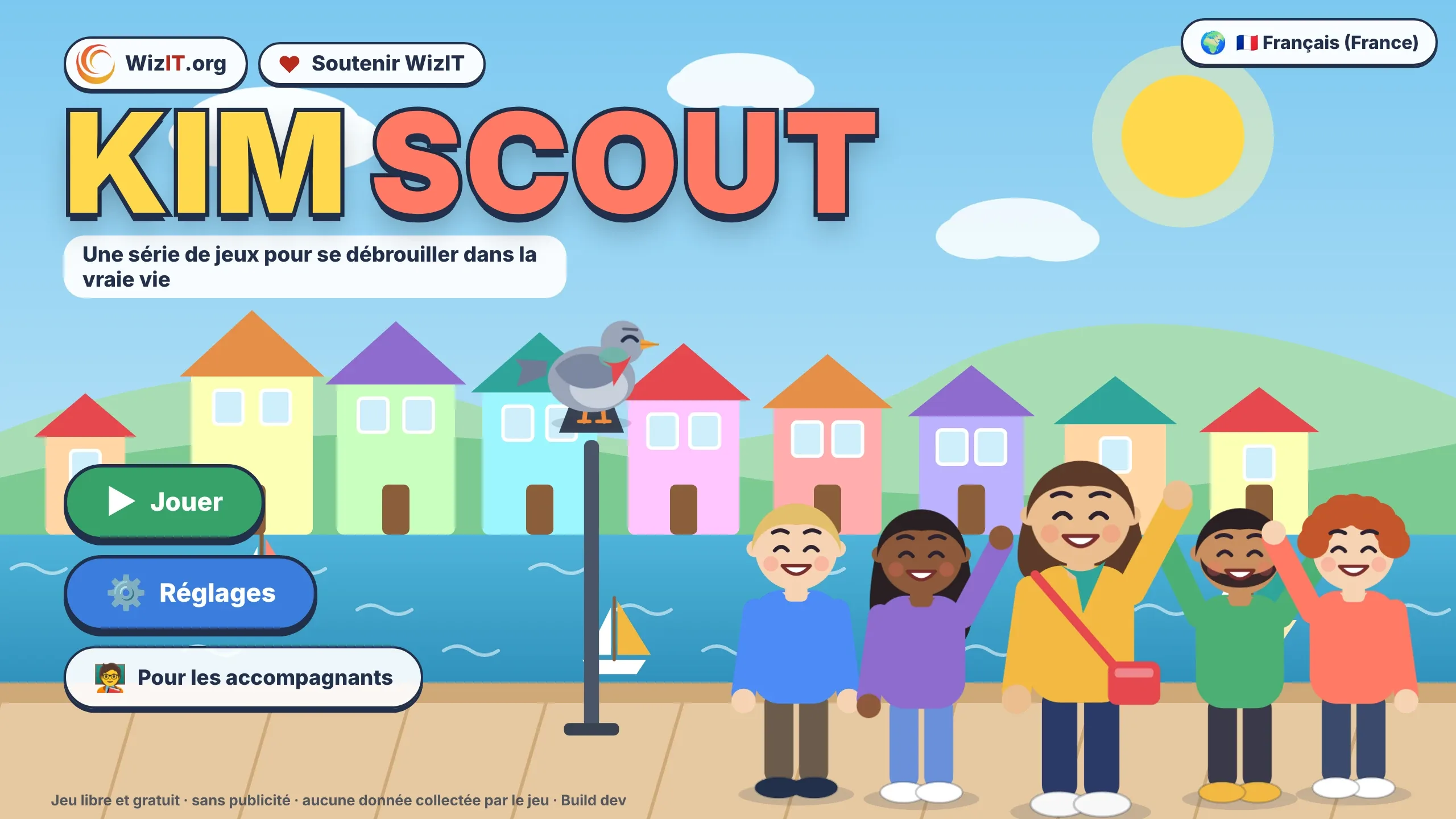
The Kim Scout home screen: the title “Kim Scout” in large yellow and red letters, colourful houses by the water, a pigeon perched on a lamp post, five smiling characters raising a hand, and three buttons on the left — Play, Settings and For carers and support workers.
The home screen Kim and friends on the harbour of Port-Lilas, with Roucou the pigeon. Three buttons: Play, Settings and For carers and support workers.
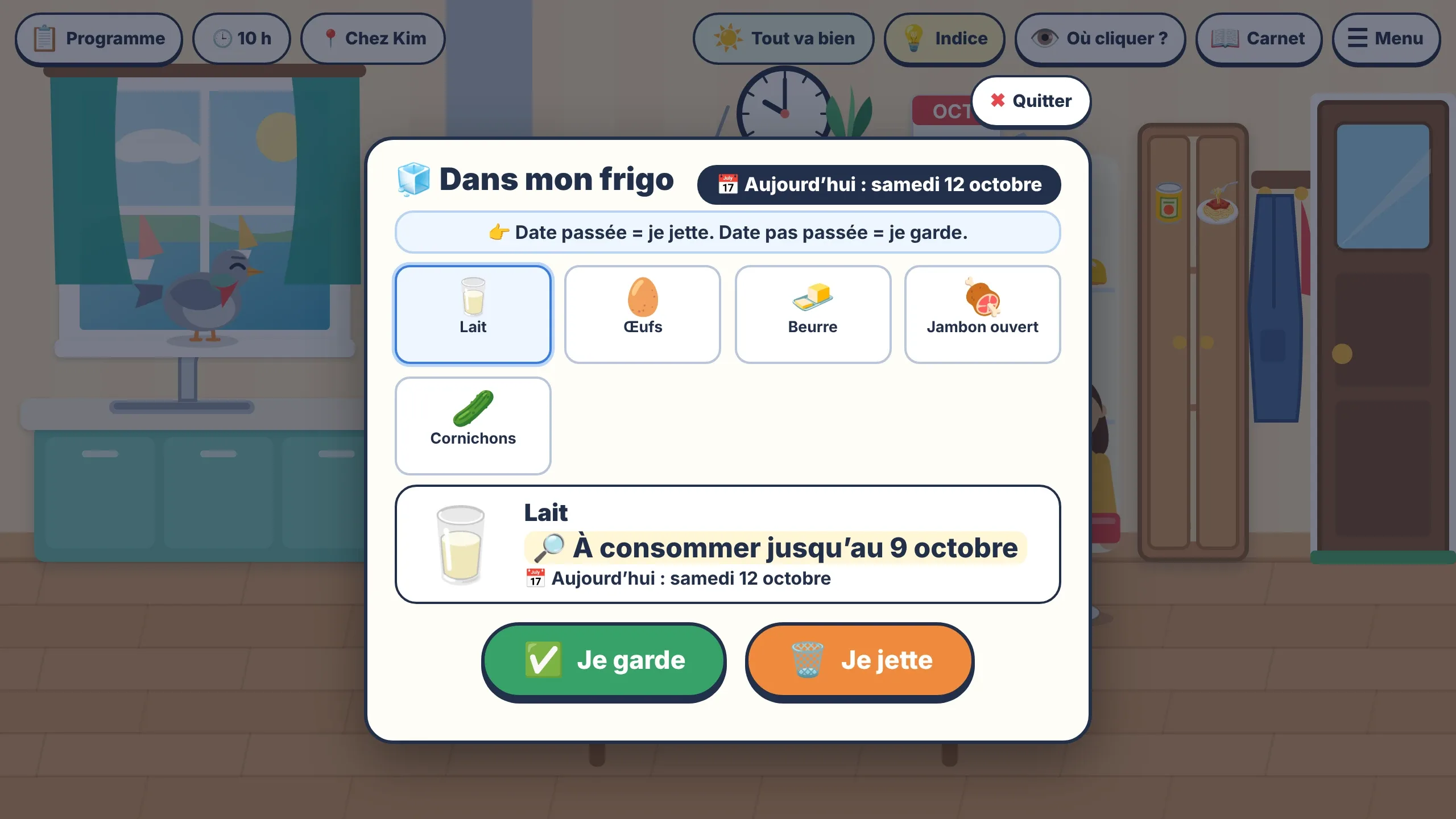
An “In my fridge” window over Kim's kitchen: today's date, “Saturday 12 October”, the rule “Date passed = I throw it away. Date not passed = I keep it.”, five products — milk, eggs, butter, opened ham, gherkins — and, under the chosen milk, its date “Use by 9 October” with two buttons, I keep it and I throw it away.
Reading a date In the fridge, the person touches a product to read its date, then chooses: “I keep it” or “I throw it away”. The rule stays written at the top.
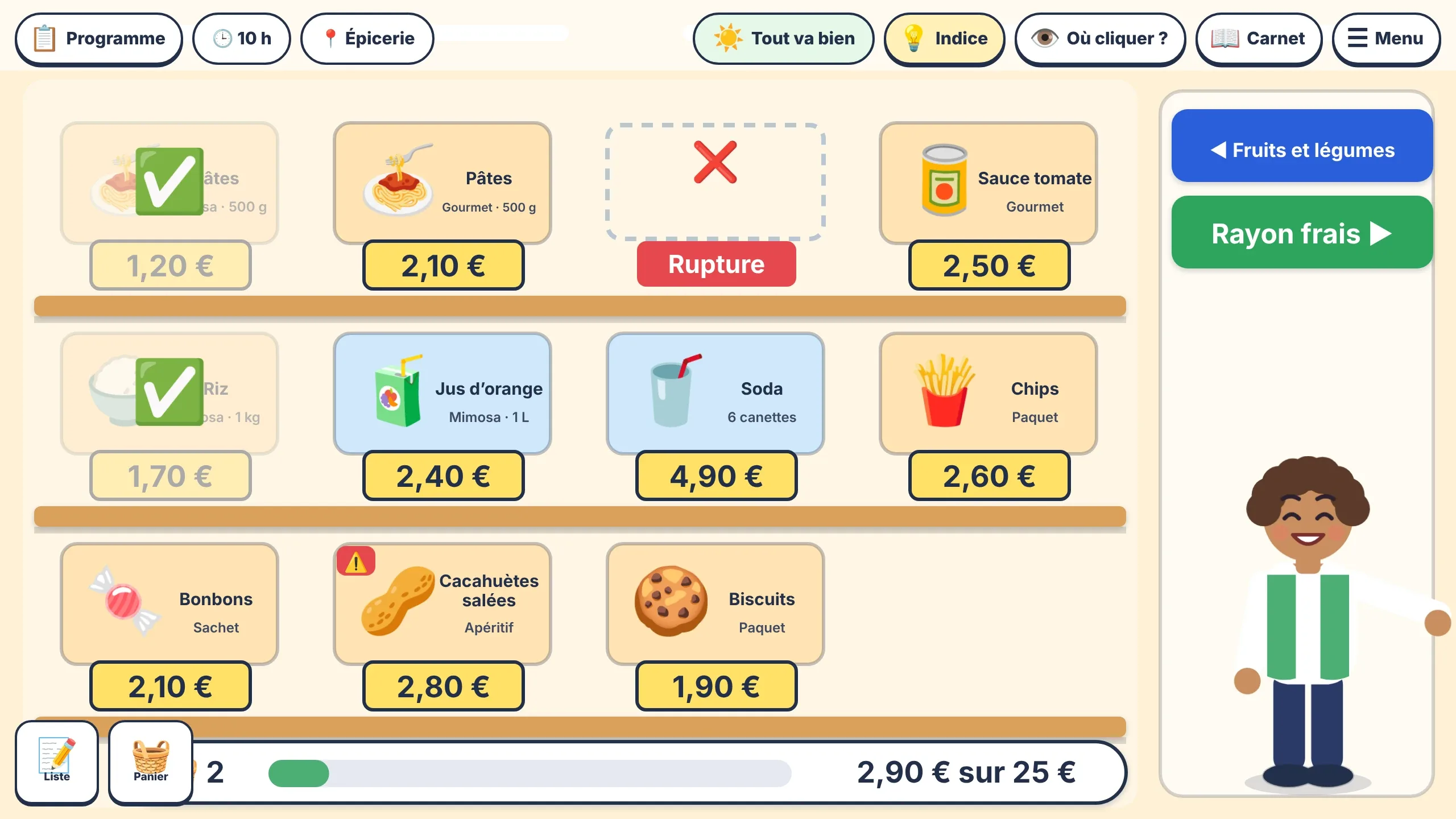
The grocery aisle of a supermarket: three shelves of products with their prices, including pasta at €1.20 and rice at €1.70 ticked in the basket. A box crossed with a red cross carries the label “Out of stock”. At the bottom, a bar reads “€2.90 out of €25”. An employee smiles on the right, next to two buttons, Fruit and vegetables and Fresh aisle.
Shopping Each product has its price, and a bar shows the budget: here €2.90 out of €25. The tomato sauce is out of stock: it is a surprise to deal with.
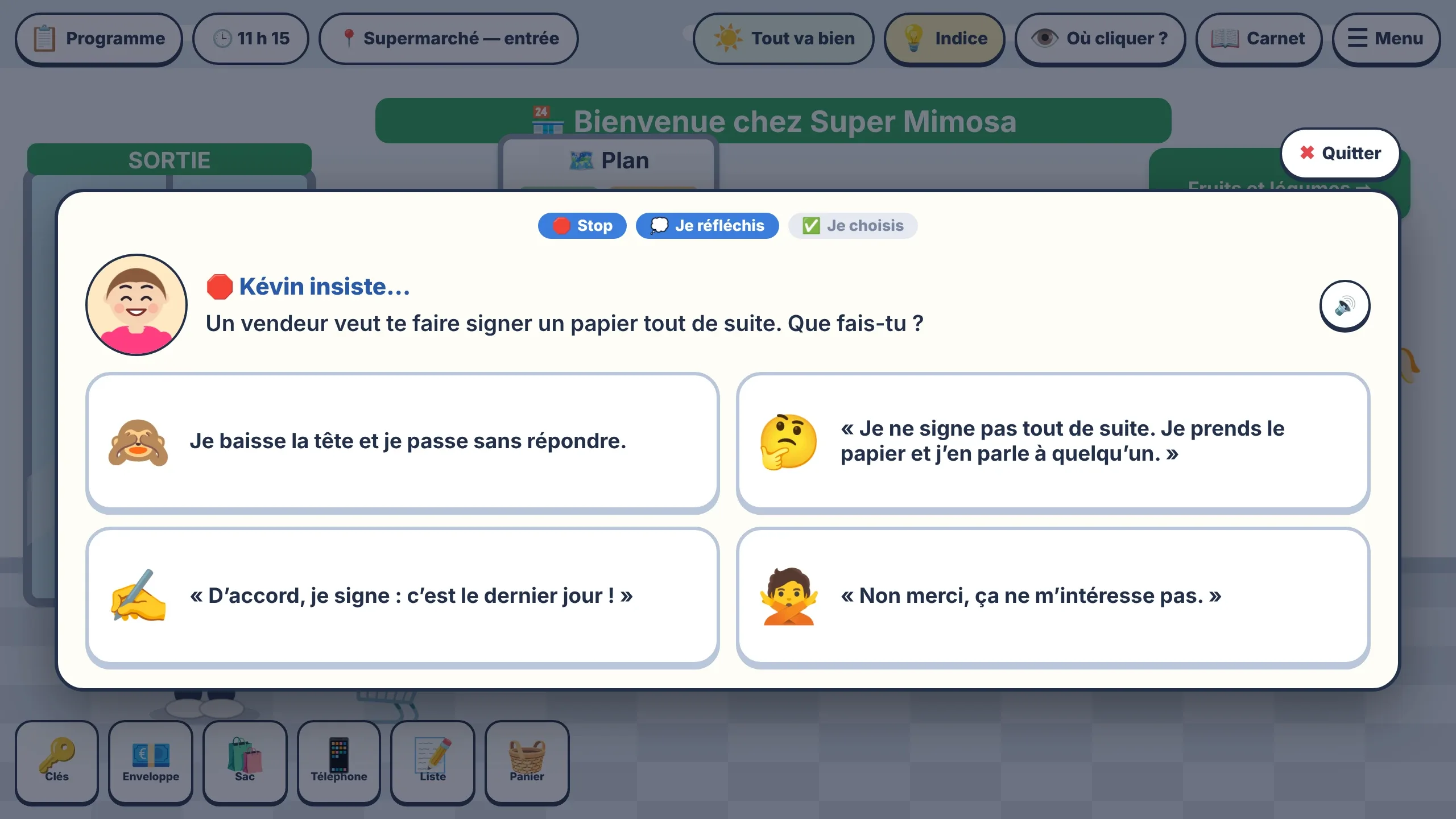
A “Kévin insists…” window: three chips — Stop, I think, I choose — then the question “A salesman wants you to sign a paper right now. What do you do?” and four answers: lower your head and walk past without answering, not sign right away and talk to someone about it, sign because it is the last day, or say “No thank you, I am not interested”.
A salesman insists A salesman wants to have a paper signed right away. The scout's three steps — Stop, I think, I choose — show at the top, above four answers. A wrong answer gets an explanation, not a “you lose”.
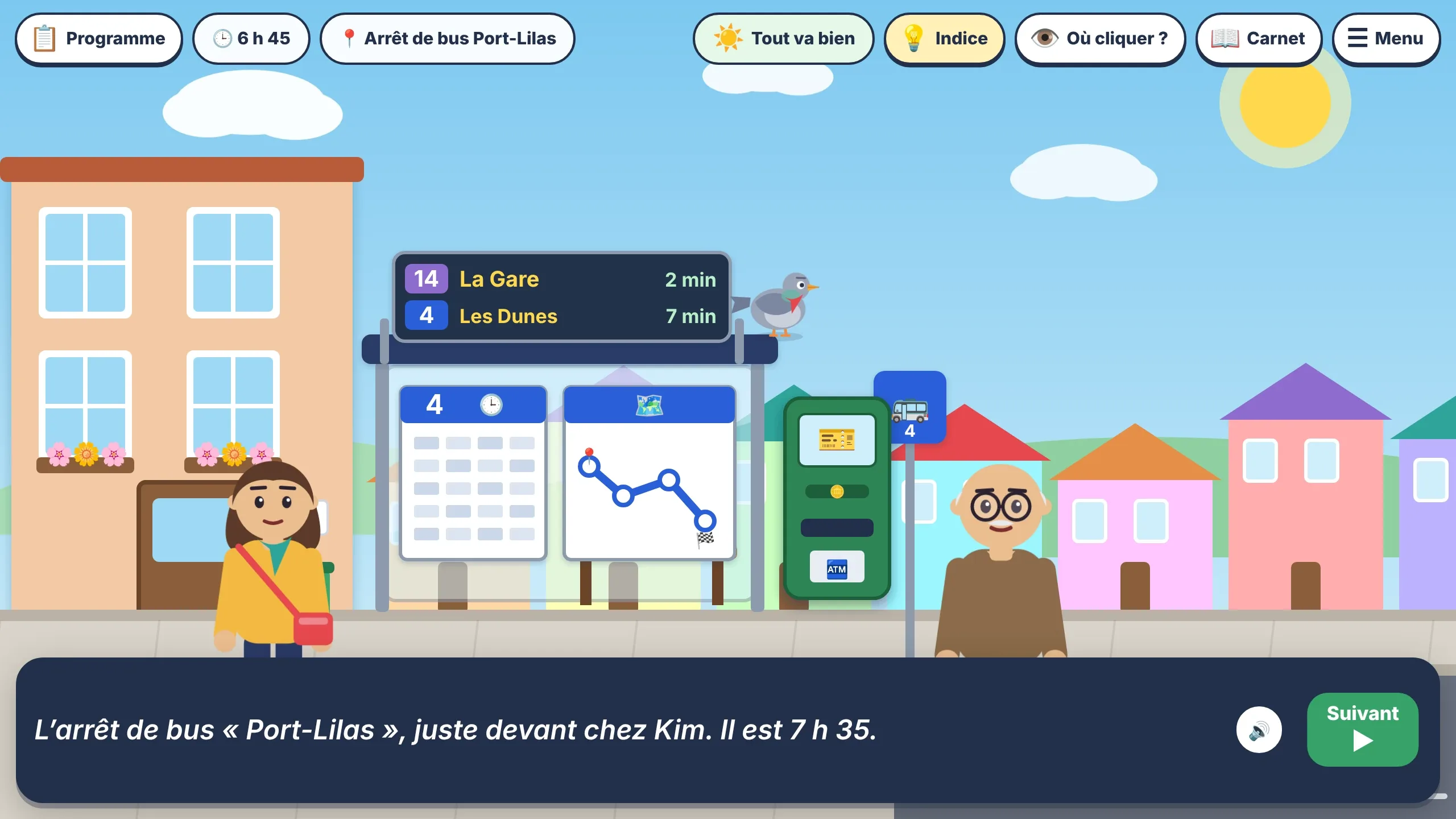
The “Port-Lilas” bus stop: a screen announces bus 14 “La Gare” in 2 minutes and bus 4 “Les Dunes” in 7 minutes, below which a timetable and a line map are displayed. On the right, a ticket machine, then Mr Dubois. At the bottom, a text says “The “Port-Lilas” bus stop, right in front of Kim's home. It is 7:35.”, with a speaker button and a Next button.
Episode 2: the bus At the “Port-Lilas” stop, you have to read the timetable and the line map, then buy a ticket at the machine. Every text is read aloud, and the speaker button reads it again.
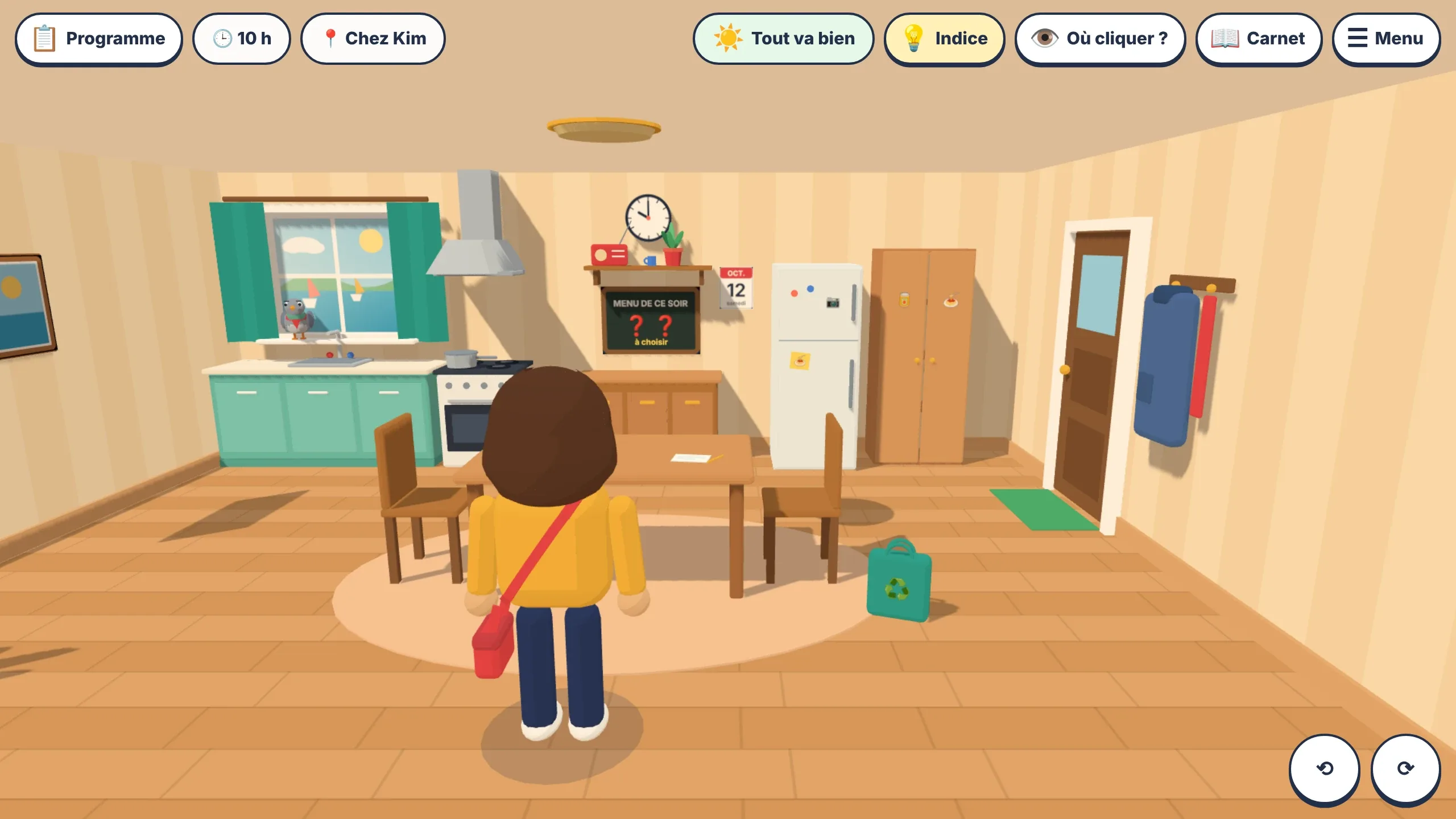
Kim's kitchen in 3D: Kim, seen from behind, in the middle of the room, with the table and two chairs in front of Kim. Around: the sink under the window where the pigeon sits, the cooker, the “Tonight's menu” slate, the fridge, the cupboard and the front door. Two rotation buttons are at the bottom right.
3D view (trial): at Kim’s Kim's kitchen in 3D, seen over the shoulder. You touch an object and Kim goes there; two buttons turn the camera.
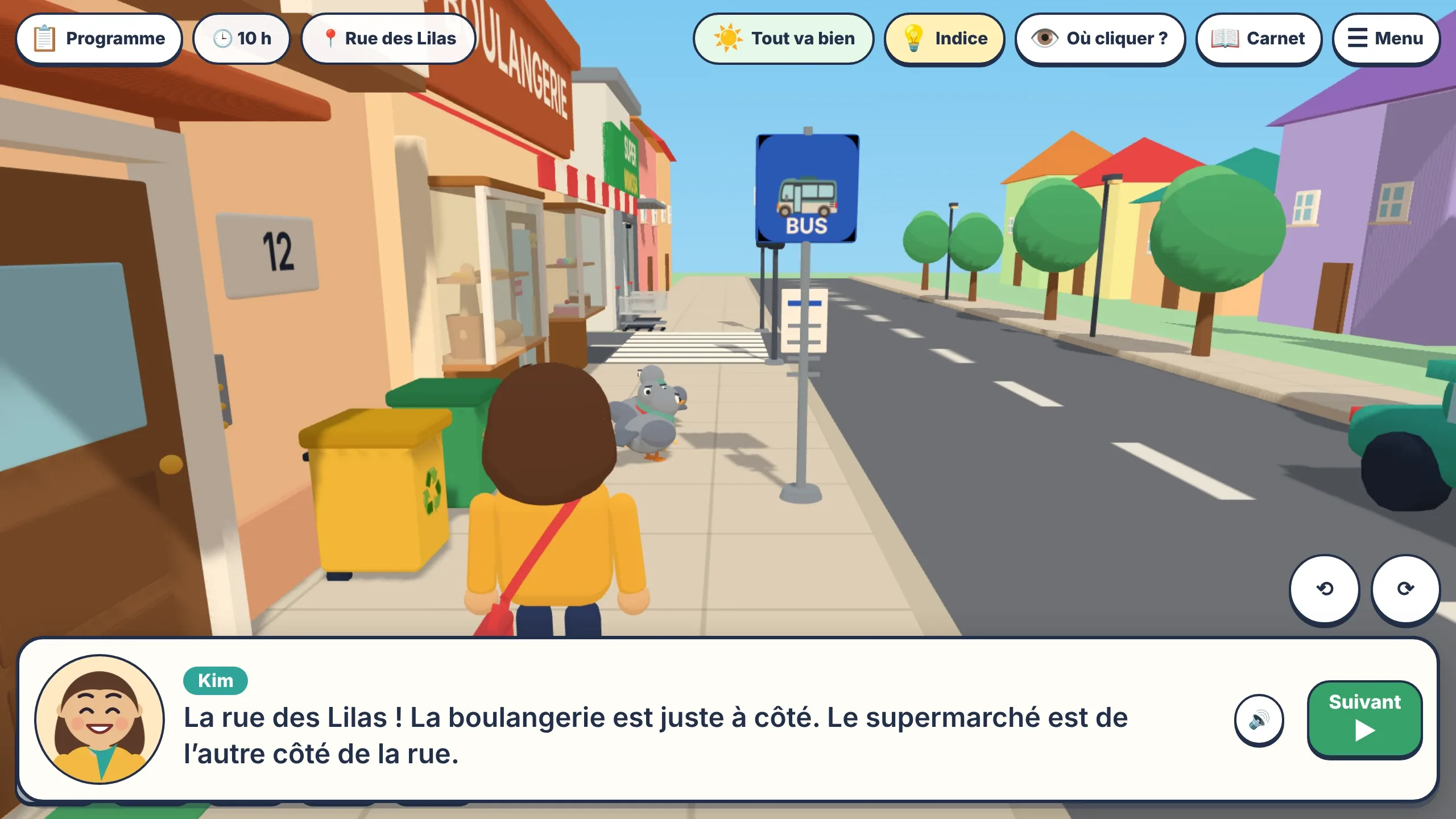
Rue des Lilas in 3D, seen from behind Kim: on the left, the front of the bakery and two sorting bins, one yellow, one green; in the background, the bus stop sign and a pedestrian crossing. Under the image, Kim says “Rue des Lilas! The bakery is right next door. The supermarket is on the other side of the street.”
3D view (trial): the street Rue des Lilas: the bakery, the bus stop, the sorting bins. Kim's lines stay written at the bottom of the screen.
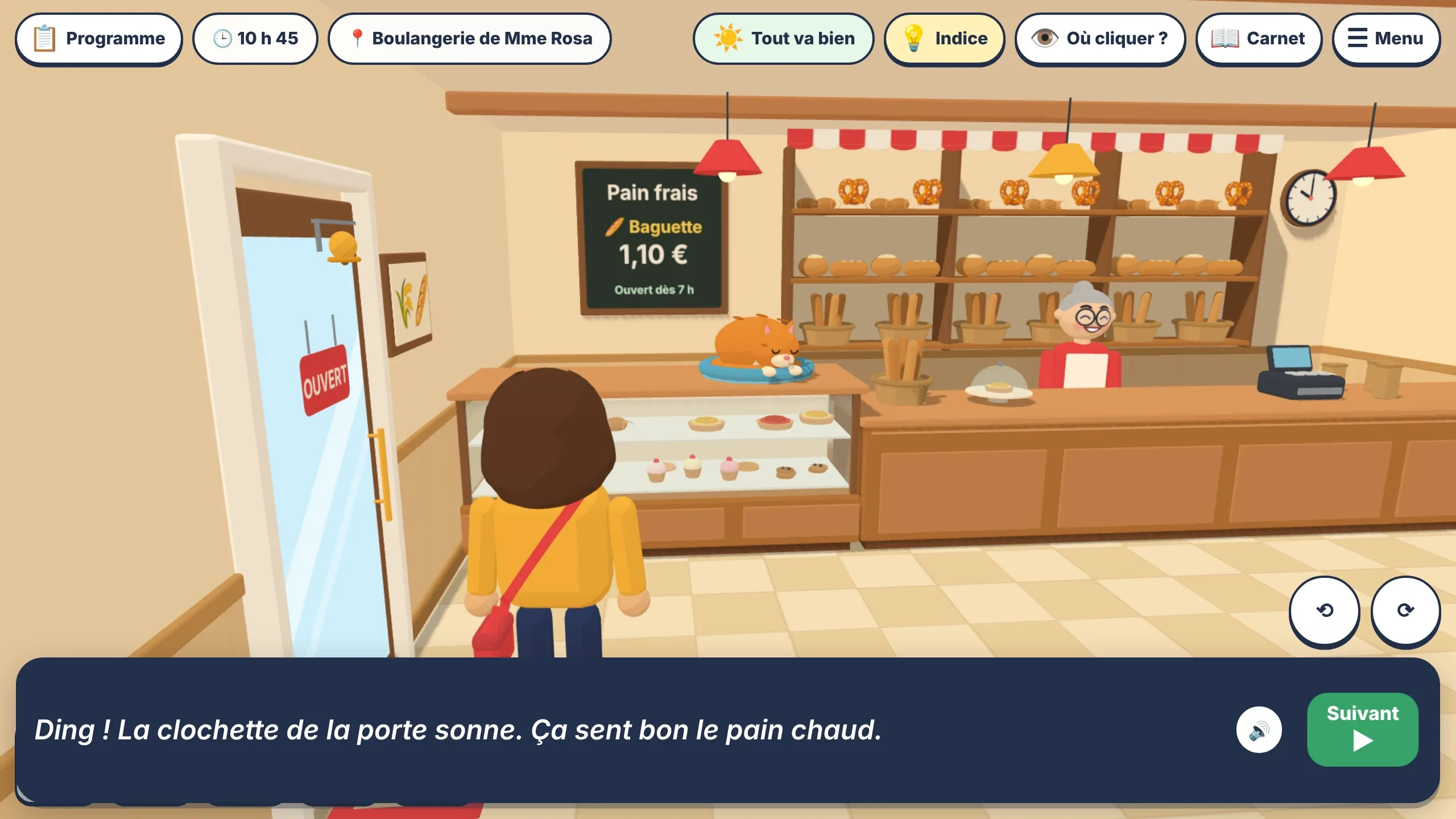
The inside of the bakery in 3D: a ginger cat sleeps on the pastry display, Mme Rosa stands behind the counter, in front of the shelves of bread, with a till on the right. A slate announces “Fresh bread, baguette €1.10”. Under the image, the text “Ding! The door bell rings. It smells of warm bread.”
3D view (trial): the bakery At Mme Rosa's, the slate announces the baguette at €1.10, which Kim will pay for with the right coins.
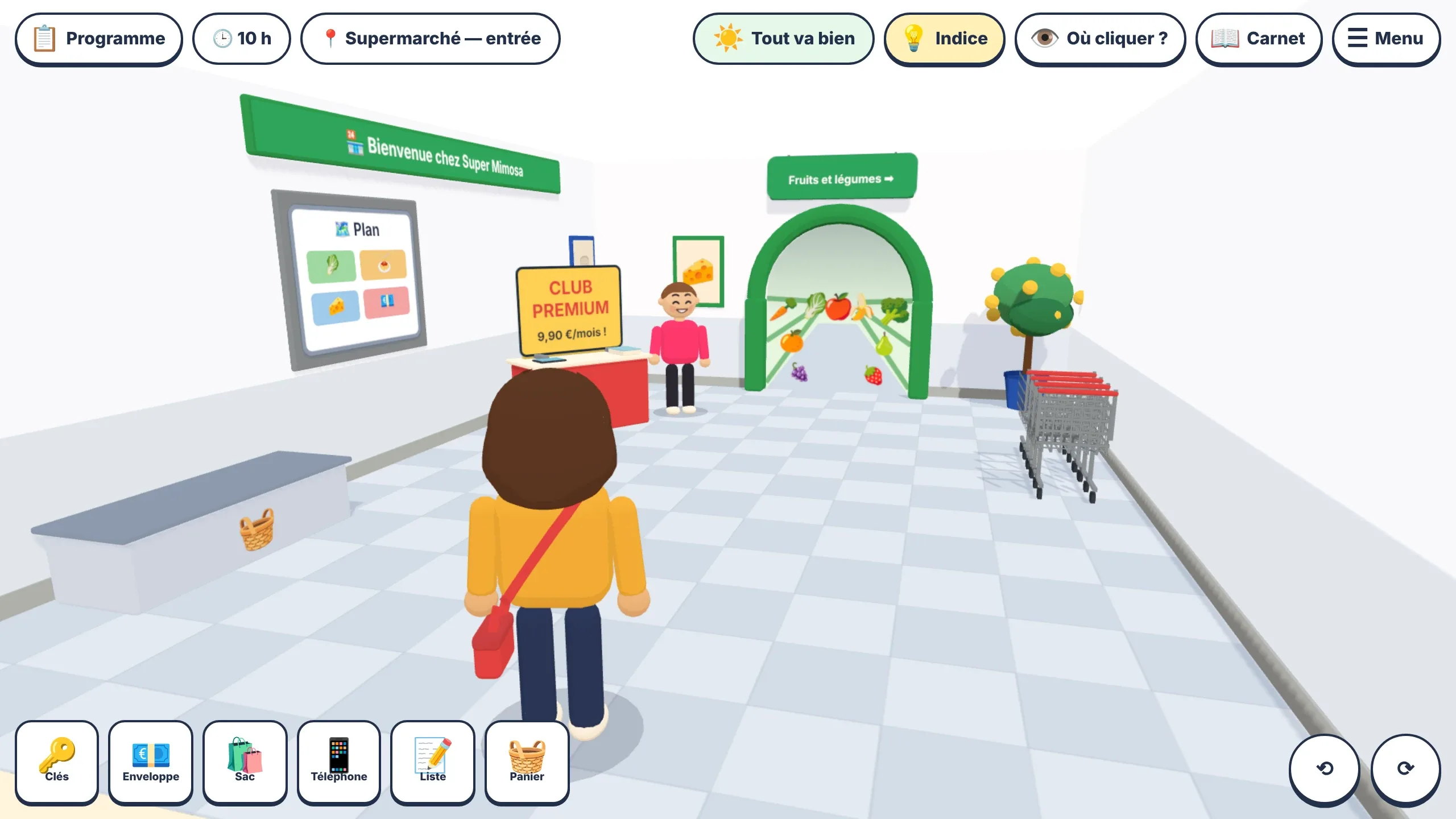
The supermarket entrance in 3D: on the left, the “Map” sign and a bench with a basket; in the centre, a yellow “Club Premium” stand in front of which Kévin stands, in a pink jumper; in the background, a green arch leading to the fruit and vegetables; on the right, a row of trolleys. At the bottom left, Kim's inventory: keys, envelope, bag, phone, list and basket.
3D view (trial): the supermarket The entrance of Super Mimosa: the store map, the fruit and vegetable arch, the trolleys, and Kévin in front of his Club Premium card.
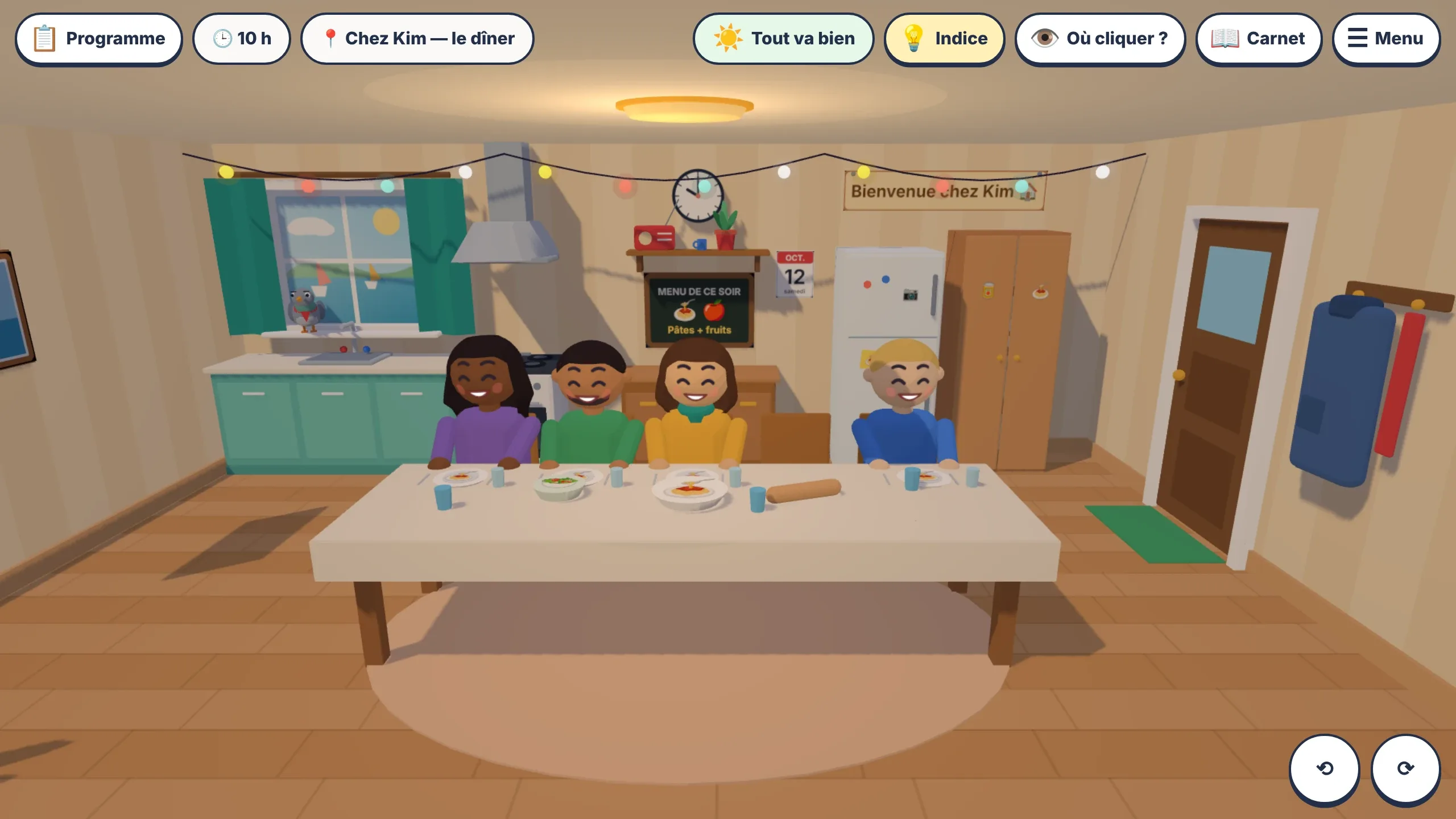
Kim's kitchen in 3D, in the evening: four smiling characters, Kim among them, sit behind a long table laid with plates, glasses and a dish of pasta. A string of lights is hung above, a banner says “Welcome to Kim's”, and the slate announces “Pasta + fruit”.
3D view (trial): the dinner The dinner of episode 1: the guests sit at Kim's table, each in front of a plate, under a string of lights.

Screenshots of the version in development, shown in French.

The game

Kim, 23, has just moved to Port-Lilas. With Roucou, a deadpan pigeon, Kim faces everyday situations: shopping, money, getting around, work, health, leisure, relationships. Each episode covers one theme, with surprises to solve, emotions to go through and relationships to build.

The game is inspired by “point-and-click” adventure games for children: you explore, you click on everything, you pick up objects, you play mini-games. Here, the heroes are young adults and the situations are real. It is aimed at adults with an intellectual disability who live in the “ordinary world”.

Where the project stands

  • Episode 1, “À table, Kim !” (“Dinner, Kim!”): shopping, money, cooking safely, having friends over. Playable, 60 to 90 minutes.
  • Episode 2, “Le bus de 7 h 42” (“The 7:42 bus”): the timetable, the line map, the ticket, a cancelled bus, asking the way. Playable, 30 to 45 minutes.
  • Episodes 3 to 15: planned. Money, work, housing, health, outings, relationships, the internet, paperwork, emergencies, purchases, travel, strong emotions, then the finale.
  • 3D view: a trial, for episode 1 only. It still has to be tested with players before going further.
  • Languages and countries: French from France and Switzerland, German from Germany and Switzerland, English from the United Kingdom. Prices, currency, emergency numbers and the voice follow the country.

Playing without help

  • Everything is read aloud: the speed can be adjusted, and every text has a button to hear it again.
  • A pictogram on every idea: short sentences, inspired by Easy Read (FALC), and text that can be enlarged.
  • The scout's three steps come back everywhere: Stop, I think, I choose or I ask for help.
  • No “you lose”: a mistake gets an explanation, then you try again.
  • You are never stuck: hints on three levels, a “Where to click?” button and the day's schedule.
  • No time pressure: a click is enough, no drag and drop. You can leave at any time.

Try the game

The game opens in the browser, on a computer or on a tablet in landscape. Nothing to install. A guide for carers and support workers is in the game, on the home screen.

No account, no ads, and the game collects no data: the save stays in the browser. One exception only: the “online” voices of Edge or Chrome send the text being read, including the player's first name, to Microsoft or Google. You turn them off in Settings.

The 3D view is a trial: it covers episode 1 only, and the game stays in 2D on a device that cannot display it. The game remembers it on the device; you turn it off in Settings.

Open the gameTry the 3D view